AI Is Not Replacing You — It's Empowering You
Worried AI will take your job? Learn how AI resume tools in India actually work, why the teaching kind beats the auto-fix kind, and how to use AI to get hired.
You're staring at your resume, cursor blinking, mind racing. You just saw another headline claiming AI will render your role obsolete, and the anxiety is real. But here's the uncomfortable truth everyone ignores: panic isn't the problem—the way you're approaching your job search is. It's time to stop fearing the algorithm and start mastering it.
Here's the thing nobody tells you in that moment: the panic is understandable, but the conclusion you're jumping to is wrong. AI isn't coming for your career. Misunderstanding AI — and using the wrong kind of AI tool — is what actually costs people opportunities.
This article is about the difference. By the end, you'll know exactly what AI resume tools in India actually do, why some of them quietly hurt your chances, and how to use AI as a multiplier instead of a crutch.
Why "AI Will Replace Me" Is the Wrong Question
Let's separate two very different things that keep getting mixed up in every scary headline:
- AI replacing the work a person does end-to-end — rare, and usually only true for narrow, repetitive tasks.
- AI changing how a person does their work — extremely common, and has been happening since spreadsheets replaced ledgers.
Job searching sits firmly in category two. Recruiters already use AI to sort applications. Companies already use AI to draft job descriptions. So the real question was never "will AI touch hiring." It already has. The real question is: who benefits from that — the job seeker who understands it, or the one who doesn't?
That's where AI resume tools come in. Used one way, they make you sharper, faster, and more confident. Used another way, they make you dependent on something you don't understand — which is a far bigger risk than the AI itself.
The Blind-Edit Trap: Why "AI Fixed It" Isn't the Same as "You Understand It"
Here's a scenario that plays out thousands of times a day across India's job market.
A fresher uploads their resume to a generic AI tool. Ten seconds later, it spits out a "improved" version — reworded bullet points, a new summary, maybe a slicker layout. The job seeker downloads it, feels relieved, and moves on.
Then the interview happens. The recruiter asks, "Walk me through this bullet point about improving efficiency by 30%." And the candidate freezes — because they didn't write it. The AI did. They don't actually know where that number came from, why it's phrased that way, or how to defend it.
This is the blind-edit trap. The resume looks better. The person hasn't learned anything. And the moment they need to explain their own experience out loud, the gap becomes obvious.
Blind-Edit AI vs. Teaching AI: A Side-by-Side Look
| Blind-Edit AI Tools | Teaching-First AI Tools (like CV Ninja) | |
|---|---|---|
| What it does | Rewrites your resume automatically | Scans your resume and shows you exactly what's wrong |
| What you get | A "fixed" file | A report: what's missing, why it matters, how to fix it |
| What you learn | Nothing — it's a black box | How ATS systems actually read resumes |
| Interview readiness | Risky — you may not recognize your own resume's claims | Strong — every change is one you made and understand |
| Long-term value | Works for one resume, one time | Skills transfer to every future resume and job application |
| Ownership | The AI's resume, technically | Still 100% your resume |
The difference isn't cosmetic. It's the difference between renting a skill for one afternoon and actually owning it.
What Empowerment Actually Looks Like
"AI empowering you" sounds like a nice phrase until you see it in action. Here's what it looks like in practice.
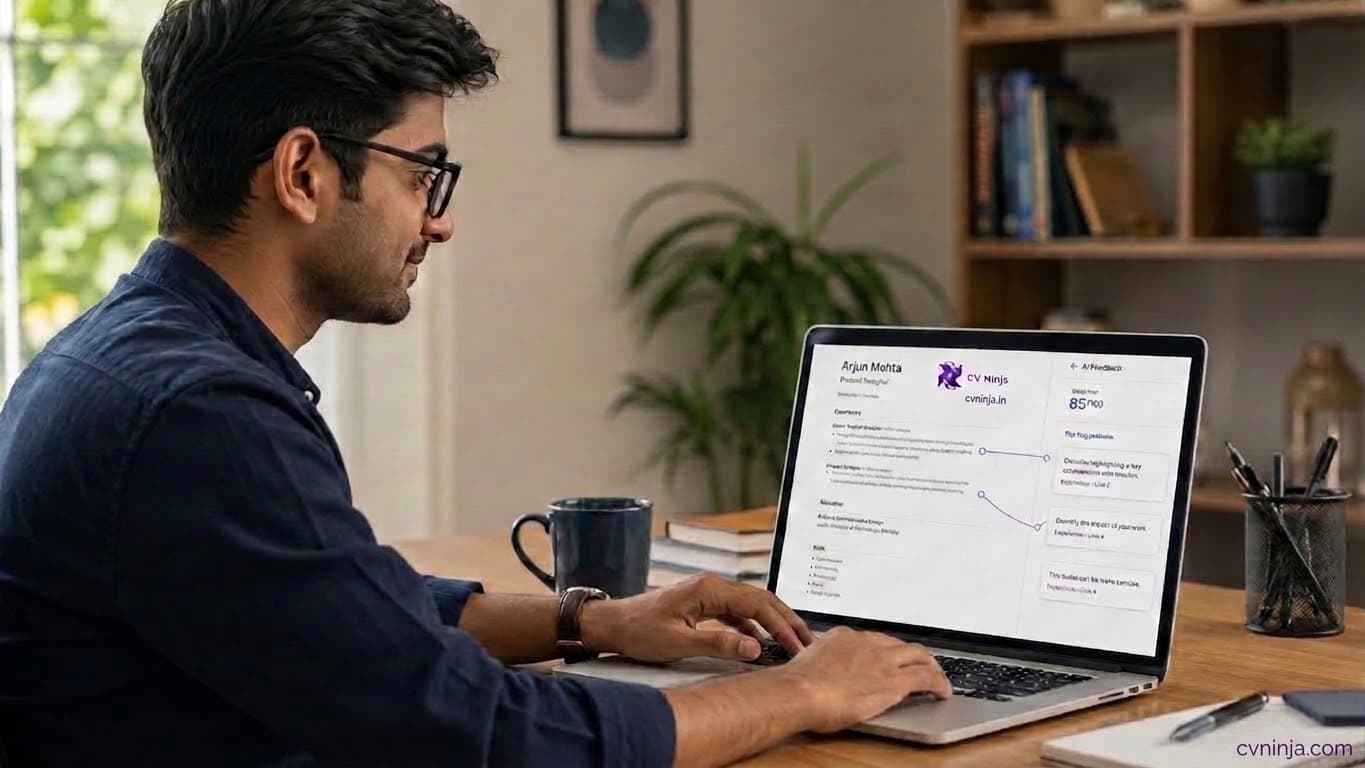
Say you run your resume through CV Ninja's ATS Resume Score checker. Instead of a vague "72/100," you get something like:
- Missing keyword: "stakeholder management." The job description mentions it twice. Your resume doesn't mention it once — even though your project work clearly involved it.
- Formatting issue: two-column layout detected. Most ATS parsers read this as scrambled text. Recruiters using the same software may never see your experience section properly.
- Header issue: "Experience" is styled as an image, not text. The system can't detect this section at all.
Notice what's happening here. You're not just told "your resume needs work." You're told what is wrong, why it matters to a machine and a human recruiter, and how to fix it using your own words and your own experience.
The next time you apply for a job — six months from now, a different role, a different industry — you don't need the tool to hold your hand. You already know to check for keyword overlap. You already know two-column layouts are risky. You already know headers need to be plain text. That knowledge is yours now. It didn't disappear when you closed the tab.
That's empowerment. Not a machine doing your thinking. A machine sharpening your judgment until you don't need to lean on it as heavily.
Common Mistakes People Make When Using AI Resume Tools
Mistake 1: Accepting AI suggestions without reading them
If a tool rewrites a bullet point and you don't reread it before submitting, you might not notice it invented a metric, changed your job title's implied seniority, or used a skill you don't actually have. Always read every AI-suggested line as if you're about to be quizzed on it in an interview — because you might be.
Mistake 2: Treating the AI score as the whole picture
A high ATS score means your resume is machine-readable and keyword-matched. It doesn't automatically mean a human recruiter will be impressed. Use the score as a floor to clear, not a ceiling to chase.
Mistake 3: Using one AI-generated resume for every job
Different roles emphasize different skills. A resume optimized for a "Sales Executive" role at one company won't score well for a "Business Development" role at another, even if the jobs are similar. Re-run your resume through an ATS checker for each serious application.
Mistake 4: Ignoring the "why" behind a fix
If a tool tells you to add a keyword, don't just paste it in randomly. Understand why the ATS is looking for it — usually because it's central to the actual job — and make sure your resume reflects real, honest experience with it.
Mistake 5: Assuming recruiters can't tell when AI wrote your resume
Generic, overly polished, keyword-stuffed resumes with no personality are easy to spot. Recruiters read hundreds of them. A resume that sounds like a template — because an AI generated all of it with no human review — often reads that way too.
Myths About AI and Job Searching, Busted
Myth 1: "AI will write my resume so I don't need to think about it"
The truth: AI can draft, structure, and suggest. But only you know your actual achievements, numbers, and context. A resume with zero input from you is a resume that can't survive a follow-up question.
Myth 2: "All AI resume tools are basically the same"
The truth: There's a real difference between tools that auto-rewrite everything for you and tools that explain their reasoning so you can make the edit yourself. One builds a skill. The other builds a dependency.
Myth 3: "Recruiters will reject me if they know I used AI"
The truth: Most recruiters assume candidates use some kind of tool — spell-checkers, templates, ATS checkers. What they actually reject is a resume that doesn't reflect the candidate's real skills or reads as generic and impersonal.
Myth 4: "If ATS software exists, my individual effort doesn't matter"
The truth: ATS systems don't remove the human from the process — they just decide who a human sees first. Your effort still decides whether you rank in the top of that list or get lost in it.
How to Use AI as a Career Multiplier, Not a Crutch
- Start with a diagnostic, not a rewrite. Use an ATS checker to understand where your resume currently stands before letting anything touch your wording.
- Fix one issue at a time, and understand each fix. Don't apply ten suggestions blindly — apply one, understand why it mattered, then move to the next.
- Keep your own voice in every line. AI can suggest structure; the substance — your actual experience — stays yours.
- Re-check for every serious application. A resume tuned for one job description isn't automatically tuned for the next.
- Practice explaining every line out loud. If you can't explain a bullet point in an interview, rewrite it until you can.
Quick Checklist Before You Submit Any AI-Assisted Resume
- I understand every number and claim on this resume
- I could explain any bullet point out loud, unprompted
- I checked my ATS score for this specific job description
- I fixed formatting issues (no tables, columns, or image-based headers)
- Keywords added reflect real experience, not just copy-pasted terms
- The resume still sounds like me, not a template
What This Means for Freshers vs. Career Switchers
Freshers: You likely have less resume-writing experience, which makes teaching-first AI tools especially valuable. Every fix you understand now is one you won't need explained again in your next job search, two or three roles from now.
Career switchers: Your challenge is usually translation — showing how experience from one field maps to keywords and expectations in another. A tool that explains why a keyword matters helps you make that translation honestly, instead of just inserting buzzwords you can't back up.
The Bigger Picture: AI in Indian Hiring Right Now
Applicant Tracking Systems are already standard across Indian tech companies, startups, and MNCs — from Infosys and TCS to Flipkart and Razorpay. Recruiters aren't choosing between "AI hiring" and "no AI hiring." That choice was made years ago. The only real choice left is whether job seekers understand the system they're being evaluated by, or navigate it blind.
Used well, AI resume tools shrink that gap. They take a process that used to require expensive career coaches or insider knowledge and make it accessible to anyone with a resume and an internet connection. That's not replacement. That's access.
What Is AI Empowerment in Job Searching? (Featured Snippet Answer)
AI empowerment in job searching means using AI tools that explain their reasoning — showing you what's wrong with your resume, why it matters, and how to fix it — instead of tools that silently rewrite your resume for you. It builds your skills and judgment rather than replacing them.
Frequently Asked Questions
Will AI actually replace recruiters and job seekers?
No. AI changes how recruiters sort applications and how job seekers prepare them, but hiring decisions still rely on human judgment, interviews, and fit. AI handles volume and pattern-matching; people still make the final call.
Is it okay to use AI to write my entire resume?
It's risky if you don't review and understand every line. AI-generated content should be treated as a draft you personally verify, not a finished product you submit unread. You should be able to explain every claim on your resume in an interview.
How do I know if an AI resume tool is the "teaching" kind or the "blind-edit" kind?
Check whether it explains its suggestions. If it just outputs a new resume with no reasoning, it's blind-edit. If it shows you a report — missing keywords, formatting issues, why they matter — it's teaching-first.
Can recruiters tell if I used AI on my resume?
Sometimes. Overly generic, keyword-stuffed, or oddly uniform resumes can read as AI-generated with no human input. A resume that reflects your real voice and specific achievements reads very differently.
What's a good ATS score to aim for?
Generally, 75% or higher gives you a strong chance of being reviewed by a recruiter. Below 60% usually means formatting or keyword issues are holding your resume back before a human even sees it.
Does using AI tools make my resume less "mine"?
Only if you let it. If you use AI to identify gaps and then fix them in your own words, the resume stays authentically yours — the tool just helped you see what needed attention.
Are AI resume tools only useful for tech jobs?
No. ATS systems and AI resume tools are used across sectors in India — banking, e-commerce, marketing, consulting, and more. Any role with a high volume of applicants likely involves some AI-based screening.
I'm a fresher with no work experience. Can AI tools still help me?
Yes, often more than for experienced professionals. Freshers benefit from understanding resume structure and keyword-matching early, since they're building these skills for the first time.
Should I use different AI-optimized resumes for different jobs?
Yes. Job descriptions vary in emphasis and required keywords, so re-checking your resume against each specific posting gives you a more accurate, useful score.
What's the biggest risk of relying on AI for my job search?
Losing the ability to explain your own resume. If you can't speak to a claim in an interview because an AI wrote it and you never verified it, that's a bigger risk than any algorithm rejecting you.
How is CV Ninja different from other AI resume builders?
CV Ninja is built to teach, not just fix. Its ATS scanner explains what's wrong and why, and points you toward fixes using your own experience — so you improve as a resume-writer, not just get a one-time "fixed" file.
Can AI help with more than just my resume — like interview prep?
Yes. Many platforms, including CV Ninja, extend the same explain-and-teach approach to interview preparation and job search guidance, helping you understand what recruiters are actually looking for at each stage.
People Also Ask
- Is AI going to take over resume writing completely?
- What jobs are safest from AI replacement in India?
- How does an ATS actually read a resume?
- Do recruiters prefer AI-optimized resumes?
- What is the difference between an AI resume builder and an AI resume checker?
- How often should I update my resume using AI tools?
- Can AI resume tools guarantee an interview?
- What skills should I learn to stay relevant alongside AI?
- Is it ethical to use AI for job applications?
- How do I make my resume stand out even with AI-based screening?
Key Takeaways
- AI isn't replacing job seekers — it's changing how hiring already works, and has been for years.
- Blind-edit AI tools rewrite your resume without explanation, leaving you unable to defend it in an interview.
- Teaching-first tools show you what's wrong, why it matters, and how to fix it — building a skill you keep.
- A high ATS score matters, but understanding why you got that score matters more.
- The real risk isn't AI itself — it's using AI without understanding it.
Action Steps
- Run your current resume through CV Ninja's free ATS Resume Score checker.
- Read every flagged issue and understand the "why," not just the fix.
- Rewrite flagged sections in your own words using the explanation as a guide.
- Re-check your score against the specific job description you're targeting.
- Practice explaining every bullet point out loud before you hit submit.
Summary
AI hasn't replaced job seekers — it's changed the process they're navigating, and it rewards the ones who understand it. The real dividing line isn't "AI users vs. non-AI users." It's teaching tools vs. blind-edit tools, and job seekers who verify vs. those who submit blindly. Choose the tool that makes you sharper, not just faster.
Final CTA
Curious what your resume actually needs? CV Ninja's free ATS Resume Score checker doesn't just fix it for you — it shows you exactly what's working, what isn't, and why, so you understand your resume a little better every time you use it.
About this article
Written and reviewed by Ram, recruiter workflow analyst at CV Ninja. Ram writes about recruiter search behavior, Naukri profile signals, job-portal keywords, and application follow-up systems.
Use this article in action
These next steps turn the advice you just read into a stronger resume, better Naukri positioning, or a faster ATS check.
Check your ATS score
Turn the advice from this article into a quick ATS check and see which fixes matter first.
Open ATS score tool
Browse ATS-friendly templates
Pick a cleaner layout that keeps your role signal, projects, and proof easy to scan.
Browse templates
See India-focused resume guides
Use the broader resume-builder hub when you want examples, structure, and city-specific guidance.
Open guide hub
Continue Reading


Resume help by city
If this article brought you in on a resume problem, these city pages help you turn the advice into a stronger resume for high-intent Indian job markets.
Mumbai
Create a professional resume for Mumbai job market. AI-powered resume builder optimized for Naukri, LinkedIn & top Mumbai companies. Free to start.
Bangalore
Create an ATS-optimized resume for Bangalore tech jobs. Perfect for IT professionals, software engineers & startup roles. Free AI resume builder.
Delhi NCR
Build a professional resume for Delhi NCR job market. AI-powered builder with formats optimized for government, corporate & MNC roles. Free to start.
Hyderabad
Create an ATS-optimized resume for Hyderabad jobs. Ideal for IT, pharma, and startup professionals. AI-powered & free to start.
Chennai
Create an ATS-friendly resume for Chennai job market. Perfect for IT, manufacturing & automotive professionals. Free AI resume builder.
Pune
Build a professional resume for Pune job opportunities. AI-powered builder optimized for IT, manufacturing & automotive sectors. Free to use.
Ready to Build Your Resume?
Create a professional, ATS-friendly resume in minutes with CV Ninja's AI-powered resume builder.
Get Started Free