Resume Mistakes India: 15 Fixes
The 15 resume mistakes costing Indian job seekers interviews — from photos and objectives to two-column layouts and weak bullets — with a specific fix for each one.
15 Resume Mistakes That Cost Indians Jobs Every Day (And How to Fix Them)
A recruiter at a Bangalore tech company opened her inbox this morning with 47 new resume submissions. She skimmed the first five in under 90 seconds and deleted four of them.
Why? Not because these candidates lacked skills. Not because they were unqualified. She deleted them because:
- One had a resume titled "Curriculum Vitae" like it's 1995
- Another's professional photo was a crop from a wedding picture, ethnic wear and all
- A third began with the objective: "To get a job that pays well and has a good work environment"
- The fourth had listed "listening to music" and "watching cricket" as hobbies in the skills section
These aren't outliers. These are everyday mistakes made by talented, capable Indian job seekers who never got the memo on what modern resume standards are.
The gap between "your resume is good enough" and "your resume is excellent" isn't talent. It's attention to detail. And in India's hyper-competitive job market, where top companies get 500+ applications for a single role, that gap is the difference between interviewed and invisible.
Let's walk through the 15 resume mistakes I see constantly from Indian candidates, and more importantly, how to fix each one.
Mistake 1: Using an Unprofessional or Inappropriate Photo
The Problem: Your resume photo was taken at your cousin's wedding. You're in a saree with flowers in your hair, or a kurta with a tilak. It's a beautiful photo, but it's not professional.
Other photo sins: Filter-heavy selfies, casual gym photos, photos taken against busy backgrounds, and pictures that are 5+ years old and look nothing like you now.
Why it matters: Recruiter unconscious bias is real. You might disagree with it, and you'd be right to. But a resume with an inappropriate photo gets filtered out faster because the cognitive load jumps—the recruiter is distracted by "wrong signal" instead of reading your experience.
The fix: Get a professional headshot. No, you don't need to go to a studio. Modern phones take excellent professional photos. Guidelines:
- White, light gray, or muted background
- Professional attire (blazer or formal shirt, no graphics)
- Good lighting (natural light, daytime)
- Head-and-shoulders framing
- Neutral expression, slight smile
- Recent photo (last 6-12 months)
Cost: Free to 1000 rupees via a friend with a good phone and decent lighting. Value: Immeasurable.
Mistake 2: Writing an Outdated Objective or Worse, No Objective
The Problem: "To secure a challenging position in an esteemed organization where I can contribute my skills and grow my career."
Or: "Seeking a role where I can leverage my expertise and achieve personal and professional growth."
These objective statements are so generic that 70% of Indian job seekers have written the exact same thing. Recruiters skip them entirely because they communicate zero information.
Why it matters: An objective statement is your chance to immediately signal fit. Wasted objective = wasted real estate.
The fix: Either skip the objective entirely (modern, preferred approach) or write a specific professional summary in its place.
Good professional summary examples:
For a Data Scientist: "Data scientist with 4 years of experience in machine learning model development, leading predictive analytics projects that improved business outcomes by 30%. Specialized in Python, scikit-learn, and AWS cloud deployment."
For a Product Manager: "Product leader with 6 years driving user engagement and revenue growth at fintech startups. Expertise in mobile product strategy, cross-functional leadership, and data-driven decision making."
These summaries tell recruiters immediately: WHO you are, WHAT you do, and WHY you're relevant. They take 15-20 seconds to write but replace 3 paragraphs of generic fluff.
Mistake 3: Listing Hobbies or Irrelevant Personal Interests
The Problem: "Hobbies: Reading novels, watching movies, playing cricket, traveling, listening to music"
You know who else has these hobbies? 99% of India. It doesn't differentiate you. Worse, it wastes resume space that could highlight your actual qualifications.
Why it matters: Every line on your resume is real estate. If it's not communicating capability, it's wasting space. Resume readers spend 6-7 seconds per page. That cricket fact is taking a second that could go toward describing your actual achievements.
The fix: Skip generic hobbies entirely. If you have unusual hobbies that demonstrate capability, include them:
- "Published author of three books on software architecture" (relevant for technical leadership roles)
- "Marathon runner; completed 12 marathons including Boston Marathon 2025" (shows discipline, relevant for demanding roles)
- "Open-source maintainer; GitHub project with 5K+ stars" (highly relevant for engineering roles)
If your hobbies don't demonstrate a relevant skill or unique capability, leave them off.
Mistake 4: Mentioning Father's Name or Caste
The Problem: Some Indian resume formats include "Father's Name: [Name]" or marital status or caste/religion indicators.
This was standard decades ago. It's now a red flag.
Why it matters: Most modern companies use blind resume screening (hiding certain personal details to reduce bias). Including father's name triggers HR compliance concerns. Some jurisdictions now consider this discriminatory information. It also makes your resume look outdated.
The fix: Remove it entirely. Your resume should include:
- Your name
- Your contact information (email, phone)
- Your professional summary or headline
- Your experience, education, and skills
That's it. Not your father's name. Not your marital status. Not your religion. Just professional information.
Mistake 5: Using a Non-Professional Email Address
The Problem: Your email is "piyush_xx69@gmail.com" or "ananya.love.movies@yahoo.com" or something equally casual.
Why it matters: Your email is part of your professional brand. An unprofessional email makes your entire application feel less serious. Some automated ATS systems also filter for professional email formats.
The fix: Create a professional email for job applications. Best format: "firstname.lastname@gmail.com" or "firstnamelastname@gmail.com"
If your name is too common, add a middle initial: "sarahj.sharma@gmail.com"
Cost: Free. Do it today.
Mistake 6: Inconsistent Formatting and Chaotic Design
The Problem: Your resume has multiple fonts, inconsistent spacing, misaligned columns, and a design that looks like you threw it together in 30 minutes. Colors are all over the place. Section headers are different sizes.
Why it matters: ATS systems struggle with complex designs. Human recruiters get distracted by poor formatting instead of focusing on content. Your resume is your first impression of your attention to detail.
The fix: Use a clean, ATS-compatible template. Guidelines:
- One or two consistent fonts (Calibri, Arial, or Times New Roman work fine)
- Consistent spacing between sections (12pt space between sections)
- Left-aligned text (easier to read, better for ATS)
- No graphics, tables, or complex formatting (ATS can't parse these)
- Use bold for section headers and job titles, not colors or underlining
- Stick to one page per 5 years of experience (so a 6-year career = 1.5 pages max)
CV Ninja's templates are all ATS-optimized and professionally designed. No formatting headaches.
Mistake 7: Vague Job Descriptions Without Metrics
The Problem: "Responsible for managing projects and coordinating with team members. Worked on various projects and contributed to team success."
Why it matters: This description doesn't tell a recruiter what you actually accomplished. Vagueness signals lack of impact. Metrics and specificity signal real achievement.
The fix: Replace vagueness with specific achievements and numbers.
Before: "Managed development of mobile application and led a team"
After: "Led development of iOS mobile application used by 50,000+ users; decreased app load time by 40% through optimization; managed team of 4 engineers to deliver features 2 weeks ahead of schedule"
Every achievement should answer: What did you do? What was the impact? What metrics prove it?
Mistake 8: Listing Responsibilities Instead of Achievements
The Problem: "Responsible for database management, server maintenance, and team coordination"
Why it matters: Responsibilities describe the job. Achievements describe you. Recruiters care about what you accomplished, not what your job description required.
The fix: Reframe every responsibility as an achievement using the format: "Action + Task + Result"
Before: "Responsible for database optimization"
After: "Optimized database query performance, reducing page load time from 8 seconds to 2 seconds and improving user retention by 25%"
Before: "Led team meetings and coordinated project timelines"
After: "Led cross-functional team of 6; implemented Agile process that reduced project delivery time by 30% and improved team accountability"
Mistake 9: No Clear Career Progression or Growth Story
The Problem: Your resume shows job titles that seem random. Associate Analyst → Senior Executive → Project Coordinator. Or jobs with no discernible growth.
Why it matters: Recruiters want to see growth trajectory. Did you get better, take on more responsibility, develop new skills? If your resume doesn't show progression, it signals stagnation.
The fix: Organize your work experience to show progression. If you had multiple roles at the same company, group them together to show growth within that organization. Use job titles and descriptions to show increasing responsibility.
Example of progression:
- Software Developer (2019-2021): Built API endpoints, fixed bugs
- Senior Software Developer (2021-2023): Led team of 3 developers, architected microservices
- Tech Lead (2023-2025): Managed 8 engineers across 2 teams, owned infrastructure decisions
This narrative shows growth. Without it, your resume looks flat.
Mistake 10: Misspellings, Grammar Errors, and Typos
The Problem: "Experiance" instead of "Experience." "Lead" instead of "Led." "Coordnation" instead of "Coordination."
Your resume has 3-4 typos scattered throughout.
Why it matters: Recruiters assume typos indicate carelessness. For roles requiring attention to detail (any role, honestly), typos are automatic disqualification. In India's competitive market, why would a recruiter pick someone with a typo-filled resume when they have 50 typo-free alternatives?
The fix:
- Use spell check (all word processors have it)
- Read your resume aloud (you catch errors you'd miss reading silently)
- Have someone else read it (fresh eyes catch things you're blind to)
- Use tools like Grammarly for free grammar checking
- Read it backward, line by line (slows you down, catches errors)
Zero typos is non-negotiable.
Mistake 11: Listing Old Technology or Irrelevant Skills
The Problem: Your skills section includes "MS Office," "Email Management," "Basic Computer Skills."
Or you're listing technology from 10 years ago that no company is hiring for.
Why it matters: These skills are assumed. Every professional knows email. MS Office is baseline. Listing them wastes space and signals you don't understand what matters. Old technology signals you're out of touch with current industry trends.
The fix: List skills that are:
- Relevant to your target role
- Current (within last 3-4 years)
- Specific, not generic
Bad skills list: "Hard-working," "Team player," "Good communication," "MS Office"
Good skills list: For a Data Analyst - "Python, SQL, Tableau, Power BI, Excel (advanced), Google Analytics, A/B testing, statistical analysis"
Mistake 12: No Achievement Stories or Quantifiable Impact
The Problem: Your resume describes what you did but not what difference it made.
"Designed marketing campaign" vs. "Designed digital marketing campaign that increased click-through rate by 35% and generated 50,000 leads"
Why it matters: Recruiters need to see impact to assess your value. Without metrics, you're just another candidate who "did their job."
The fix: Add numbers, percentages, and impact statements to every role:
- Revenue/cost impact: "Reduced operational costs by 20%, saving ₹50 lakhs annually"
- Scale impact: "Managed platform serving 100,000+ daily active users"
- Team impact: "Mentored 5 junior developers, 3 of whom got promoted"
- Speed impact: "Cut project delivery time by 40% through process optimization"
- Quality impact: "Reduced bug rate by 60% through implementation of automated testing"
Mistake 13: Unrealistic Job Titles or Inflated Responsibilities
The Problem: You were an Associate, but your resume says "Senior Executive." Or you helped with a project, but your resume says "Led project that earned company ₹10 crore."
Why it matters: Recruiters verify job titles with your company. Inflated titles are red flags. They signal dishonesty. When they call your previous employer to verify and hear "Actually, they were an Associate, not a Senior Executive," your candidacy dies instantly.
The fix: Use your actual job title. If it's misleading (like "Executive" when you had minimal responsibility), use your actual title but contextualize it in your description:
"Associate, Product Management (responsibilities of mid-level PM): Led cross-functional team on key feature launch; managed product roadmap; conducted 50+ customer interviews"
Honest but contextual is always better than inflated.
Mistake 14: No Contact Information or Outdated Contact Details
The Problem: Your resume has a phone number that's disconnected or an email you don't check regularly. Or no phone number at all, hoping recruiters will only email.
Why it matters: Recruiters move fast. If they can't reach you immediately, they move to the next candidate. A recruiter wants to call about an interview opportunity? If your number is wrong, you're out.
The fix: Include:
- Email: Check daily (or set up forwarding)
- Phone: Active, professional voicemail greeting
- LinkedIn: Optional but recommended
- Portfolio/GitHub: Only if relevant to your role
Header format: Firstname Lastname Email@gmail.com | +91-XXXXXX-XXXX | linkedin.com/in/yourname
That's all you need.
Mistake 15: Sending the Same Resume for Every Job
The Problem: You have one generic resume and send it to every job posting, regardless of role variation.
Why it matters: Each role prioritizes different skills. A job posting emphasizes "Python and machine learning" but your resume leads with "Java and web development." You're not matching the employer's priority.
The fix: Create targeted resume variants for different job types.
If you're a software engineer, create versions for:
- Backend engineer role: Lead with backend skills, frameworks, databases
- Frontend engineer role: Lead with frontend skills, frameworks, design patterns
- Full-stack engineer role: Balance both
The content is the same; the emphasis changes. The first job description gets your backend achievements first. The second gets frontend achievements first.
This targeted approach boosts your ATS match score significantly.
The Resume Audit Checklist
Before you send your resume anywhere, run this checklist:
- Professional headshot photo (or no photo)
- No father's name, marital status, caste, religion
- Professional email address
- Consistent, clean formatting
- Clear professional summary or headline (no generic objective)
- 15-20 relevant, current skills
- Every job description includes metrics and impact
- Jobs show career progression
- No hobbies listed
- Zero typos (read aloud, use grammar checker)
- Honest job titles, no inflation
- Current contact information
- Tailored for your target role's priorities
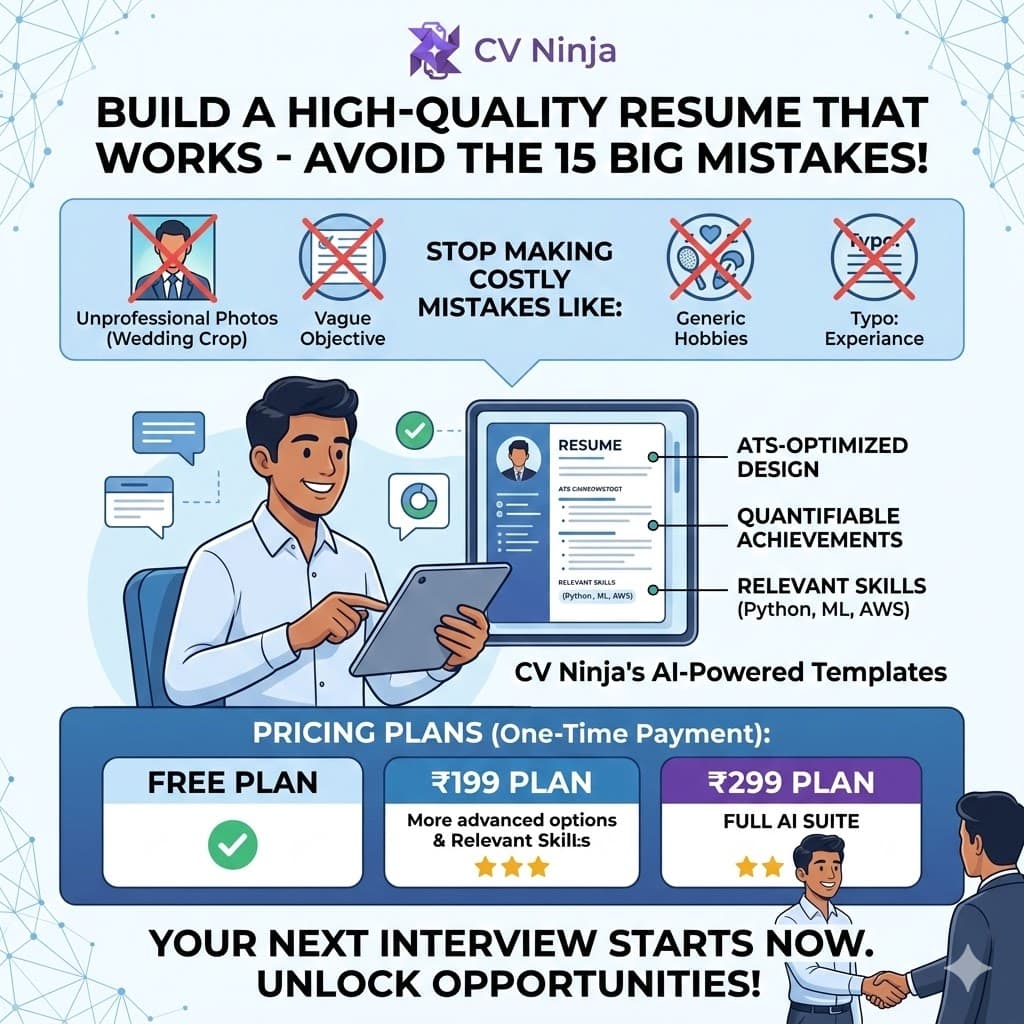
Stop losing opportunities to resume mistakes. Build your resume with CV Ninja—our AI-powered templates guide you away from these 15 mistakes while highlighting your actual achievements. Plus, our ATS Score Checker catches formatting and keyword gaps before you send. Plans start at Free,199 and 299rs one time. Your next interview starts with a resume that actually works.
Now check it against your own resume
Advice only helps once you know which parts apply to you. Run your current file through the free ATS resume score checker for parsing, keyword gaps, bullet quality, and recruiter scan — scored in seconds with no account needed.
Sources used in this guide
We use external hiring, ATS, and skills research to keep the advice grounded in real recruiter behavior instead of generic resume folklore.
About this article
Written and reviewed by Rajvi, ats and resume format reviewer at CV Ninja. Rajvi reviews resume structure, ATS readability, section order, and parser-safe formatting for Indian job applications.
Use this article in action
These next steps turn the advice you just read into a stronger resume, better Naukri positioning, or a faster ATS check.
Check your ATS score
Turn the advice from this article into a quick ATS check and see which fixes matter first.
Open ATS score tool
Browse ATS-friendly templates
Pick a cleaner layout that keeps your role signal, projects, and proof easy to scan.
Browse templates
See India-focused resume guides
Use the broader resume-builder hub when you want examples, structure, and city-specific guidance.
Open guide hub
Continue Reading



Resume help by city
If this article brought you in on a resume problem, these city pages help you turn the advice into a stronger resume for high-intent Indian job markets.
Mumbai
Create a professional resume for Mumbai job market. AI-powered resume builder optimized for Naukri, LinkedIn & top Mumbai companies. Free to start.
Bangalore
Create an ATS-optimized resume for Bangalore tech jobs. Perfect for IT professionals, software engineers & startup roles. Free AI resume builder.
Delhi NCR
Build a professional resume for Delhi NCR job market. AI-powered builder with formats optimized for government, corporate & MNC roles. Free to start.
Hyderabad
Create an ATS-optimized resume for Hyderabad jobs. Ideal for IT, pharma, and startup professionals. AI-powered & free to start.
Chennai
Create an ATS-friendly resume for Chennai job market. Perfect for IT, manufacturing & automotive professionals. Free AI resume builder.
Pune
Build a professional resume for Pune job opportunities. AI-powered builder optimized for IT, manufacturing & automotive sectors. Free to use.
Ready to Build Your Resume?
Create a professional, ATS-friendly resume in minutes with CV Ninja's AI-powered resume builder.
Get Started Free