Job Search Playbook India: Resume to Offer
The complete job search playbook for Indian professionals: from resume and ATS score to interview prep, offer negotiation, and onboarding — with tools at each step.
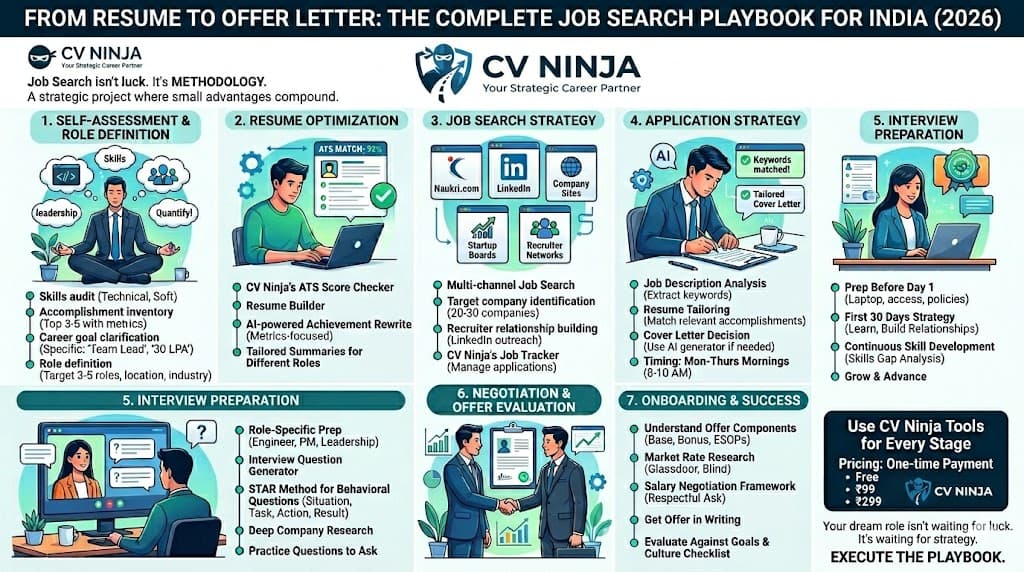
From Resume to Offer Letter: The Complete Job Search Playbook for India (2026)
Your job search isn't one decision. It's a series of forty decisions, each one compounding the next.
Decision 1: What role are you actually qualified for? Decision 2: Where should you look? Decision 3: How do you optimize your resume? Decision 4: When should you apply? Decision 5: How do you prepare for the interview? And so on.
Most job seekers make these decisions ad-hoc, reactively. They see a job posting, update their resume hastily, apply, and hope. When they don't hear back, they repeat.
The professionals who consistently land great roles—the ones getting multiple offers to choose from—approach this strategically. They have a playbook. They follow a system. They know that job search isn't luck. It's methodology.
This is that playbook.
Stage 1: Self-Assessment and Role Definition
Before you update your resume, before you open a job board, you need clarity on three things: What can you do? What do you want to do? Where's the overlap?
This stage is about reducing noise. Job boards have hundreds of thousands of listings. Without clarity on your target, you'll apply randomly, wasting time and psychological energy.
Step 1: Skills audit
List everything you can do:
- Technical skills (programming languages, tools, platforms you've used)
- Domain knowledge (industries, business functions you understand)
- Soft skills (communication, leadership, project management)
- Certifications, credentials, or formal training
Don't filter yet. Just list. Include skills you've developed at work, side projects, and even hobbies if they're relevant.
Step 2: Accomplishment inventory
For each role you've held, list your top 3-5 accomplishments. Quantify where possible:
- "Reduced manual processing time by 40%, saving 80 hours/month"
- "Led team of 5 developers; delivered 3 major product launches"
- "Increased customer satisfaction score from 72 to 88 NPS through process redesign"
This inventory becomes your interview talking points and resume content.
Step 3: Career goal clarification
Be specific. Not "I want a better job." But:
- "I want to move from individual contributor to team lead role"
- "I want to transition from finance to fintech/startup"
- "I want to move to a product management role leveraging my technical background"
- "I want to stay technical but earn 25-30 LPA in a growth-stage startup"
Write down your goal. Make it explicit.
Step 4: Role definition
Based on your skills and goal, define 3-5 specific roles you want to target. Examples:
- "Senior Full-Stack Engineer" (for tech background)
- "Product Manager, Fintech" (for finance + tech background)
- "Business Analyst, Data-Driven" (for analytical background)
For each role, note:
- Required skills you have
- Required skills you lack (and plan to learn)
- Typical salary range
- Industries/company types that hire for this
- Geographic preference (Bangalore, Mumbai, remote, etc.)
This clarity prevents spray-and-pray applications. You're now strategically targeting 3-5 role types.
Stage 2: Resume Optimization and Positioning
Now that you know what you're targeting, your resume needs to speak that language.
Step 2A: Resume audit and gaps
Use CV Ninja's ATS Score Checker to audit your current resume against your target roles.
Input a target job description. The ATS checker will tell you:
- Missing keywords your resume needs
- Sections that are incomplete
- Formatting issues that hurt ATS parsing
- Your overall match percentage
This diagnostic prevents guessing. You know exactly what's missing.
Step 2B: Resume rewrite for your target role
Using the keyword insights from Step 2A:
- Rewrite your professional summary to emphasize your target role's requirements
- Highlight accomplishments that showcase skills for your target role
- Integrate industry keywords naturally throughout
- Ensure formatting is ATS-compatible
A key insight: You're not creating one generic resume. You're creating 1-2 resume variants optimized for different role types you're targeting.
Target: Senior Backend Engineer → Lead with backend technologies (Java, Python, system design, microservices, AWS)
Target: Tech Lead/Manager → Lead with leadership accomplishments (team building, mentoring, architectural decisions, cross-functional collaboration)
Step 2C: Professional summary or headline optimization
Your headline is your billboard. On Naukri, LinkedIn, and job applications, this is what's seen first.
Weak headline: "Senior Software Engineer"
Strong headline: "Senior Backend Engineer | Java, Python, AWS, Microservices | 7 Years | Building at Scale"
The strong version includes:
- Your specific role variant
- Key technical skills
- Years of experience
- A value statement (building at scale, problem-solving, etc.)
Step 2D: Achievement rewrite
For each job, rewrite 3-5 key accomplishments using the metrics framework:
Before: "Responsible for backend development and system optimization"
After: "Architected microservices migration from monolith; reduced system latency by 60%; led team of 4 engineers; handled 10M+ daily requests"
Every achievement should answer: What did you do? What was the impact? What metrics prove it?
Use CV Ninja's AI Resume Builder to generate achievement-focused bullet points. Input your job description and accomplishments, and the AI suggests reframed, metric-rich alternatives.
Stage 3: Job Search Strategy
Now you have a resume optimized for your target role. Where do you actually find jobs?
Step 3A: Multi-channel job search
Don't rely on one job board. Different roles cluster on different platforms:
- Naukri.com: Largest job board in India. Covers all sectors. Best for: first jobs, generalist searches.
- LinkedIn: Strong for mid-to-senior roles, remote positions, and roles at well-known companies.
- Company websites: Often post roles before they hit job boards. Check careers pages of target companies directly.
- Angel List / Startup job boards: For startup roles (typically lower pay, more equity).
- Specialized boards: WomenTech.io (if applicable), StackOverflow (for engineers), Product School (for PMs), etc.
- Recruiter networks: Build relationships with recruiters on LinkedIn. Many roles are filled through recruiter outreach before being publicly posted.
Strategy: Spend 30% effort on Naukri and LinkedIn, 20% on company websites of your target companies, 30% building recruiter relationships, 20% on specialized boards.
Step 3B: Target company identification
Make a list of 20-30 companies you'd actually want to work for. Not based on prestige, but on:
- Company mission/work you believe in
- Salary and benefits aligned with your expectations
- Growth opportunities
- Work culture (remote, flexible, etc.)
- Geographic location
Visit their careers pages monthly. Many companies post roles on their website before they hit Naukri or LinkedIn. A direct application to a company you researched is stronger than a random board application.
Step 3C: Recruiter relationship building
Add 50-100 recruiters in your field to your LinkedIn. Recruiters get paid to fill roles, so they're incentivized to help you. A warm relationship with a recruiter means:
- They tell you about open roles before they're posted
- They refer you internally (improving your odds)
- They advise on salary negotiation
- They advocate for you internally
Reach out: "Hi [Name], I'm a [Your Role] with [X years] experience in [Domain]. I'm actively exploring [Target Role] opportunities at growth-stage companies. Would love to connect and explore potential fits."
Many recruiters will take 10 minutes to chat and keep you in their network.
Step 3D: Job tracker setup
Use CV Ninja's Job Tracker to manage applications across platforms. Track:
- Job title and company
- Application date
- Status (applied, interviewed, offer, rejected)
- Contact info (if you have the recruiter's name)
- Salary details
- Next steps
This prevents applying to the same job twice (embarrassing) and helps you see patterns (Are certain industries ignoring you? What's your application-to-interview ratio?).
Stage 4: Application Strategy and Optimization
You've found a role you're interested in. How do you apply strategically?
Step 4A: Job description analysis
Before applying, spend 10 minutes analyzing the job description using the keyword extraction technique:
- Highlight required skills (must-have)
- Highlight nice-to-have skills
- Note key buzzwords they use
- Identify specific technologies or domains
- Identify company priorities (read between the lines)
This analysis informs how you pitch yourself.
Step 4B: Resume tailoring
For important roles (high-interest companies, dream roles), tailor your resume to match the job description:
- If they emphasize "leadership," make sure your leadership accomplishments are prominent
- If they mention specific technologies, ensure you've used similar tools
- If they highlight "customer-focused," showcase how you've improved user satisfaction
Use CV Ninja's AI builder to generate tailored versions quickly. It's not about dishonesty; it's about emphasizing the achievements that matter for this specific role.
Step 4C: Cover letter decision
For each application, ask: "Does this role require a cover letter?"
- Yes: See our cover letter guide. Use CV Ninja's cover letter generator to create a personalized letter in 5 minutes.
- No: Skip it. Use the time for other applications.
Step 4D: Application timing
Time your applications strategically:
- Best time to apply: Monday-Thursday mornings (8-10 AM) or Tuesday-Thursday afternoons (2-4 PM)
- Avoid Fridays after 2 PM and weekends (low recruiter engagement)
- When applying on Naukri, update your profile slightly at the same time (adds a freshness signal)
Stage 5: Interview Preparation
You applied. They called. Now preparation becomes critical.
Step 5A: Company research
Before any interview, research the company deeply:
- Read their recent press releases (product launches, funding, partnerships)
- Understand their business model and revenue streams
- Know their target customers and market position
- Identify recent news, challenges, or opportunities
- Follow their social media and CEO/founders' LinkedIn
You're aiming to show genuine interest, not generic politeness. During the interview, reference something specific: "I saw you launched [product] last month. I'm curious how that's been received in [market]."
Step 5B: Role-specific preparation
Different roles have different interview focuses:
For technical roles (engineer, analyst, scientist):
- Prepare technical projects or code samples
- Practice coding problems (LeetCode, HackerRank for engineers)
- Prepare to explain past technical decisions
- Understand the role's tech stack deeply
- Use CV Ninja's Interview Question Generator to practice role-specific questions
For product/business roles:
- Prepare case studies (how you'd approach a specific problem)
- Understand the company's product roadmap
- Prepare to discuss past impact (metrics, outcomes)
- Be ready to discuss your leadership philosophy or work approach
- Practice common PM, BA, or business interview questions
For leadership roles:
- Prepare stories about team building, conflict resolution, and success
- Understand your leadership philosophy
- Be ready to discuss how you handle high performers and underperformers
- Discuss team scaling and organizational design
- Practice behavioral and leadership questions
Step 5C: STAR method for behavioral questions
Behavioral questions ("Tell me about a time you...") are standard. Prepare 6-8 stories using the STAR framework:
- Situation: Context (what was happening?)
- Task: Your challenge (what did you need to do?)
- Action: What you did (steps you took)
- Result: Outcome and impact (metrics, lessons, what you'd do differently)
Example: "Tell me about a time you solved a difficult technical problem."
Situation: At my previous company, our payment processing system was timing out during high-traffic hours. Task: We needed to reduce latency without rebuilding the entire system. Action: I analyzed bottlenecks using APM tools, identified N+1 query problems in the database layer, optimized queries, implemented caching, and coordinated rollout. Result: Reduced latency by 60%. System handled 3x traffic. Prevented a likely outage during our peak season.
Prepare 8 stories covering: challenge solved, teamwork, failure/lesson learned, impact made, innovation, leadership, conflict navigation, domain expertise.
Step 5D: Questions to ask them
Prepare 3-5 thoughtful questions for your interviewers:
- "How does this role measure success in the first 90 days?"
- "What does the career progression look like for this role?"
- "What are the biggest challenges your team is facing?"
- "How does the company support continuous learning and skill development?"
These questions show genuine interest and help you evaluate whether they're a good fit for you.
Step 5E: Interview logistics and professionalism
- Test your video/audio if it's a virtual interview (10 minutes before)
- Choose a quiet, well-lit location
- Dress professionally (match the company's dress code or go slightly more formal)
- Be 5 minutes early (virtual or in-person)
- Bring copies of your resume and notes
- Send a thank-you email within 24 hours
Stage 6: Negotiation and Offer Evaluation
You got the offer. Congratulations. Now the negotiation begins.
Step 6A: Understanding offer components
A job offer in India typically includes:
- Base salary: Your fixed annual salary
- Performance bonus: 10-25% of base for most roles (highly variable)
- Stock options: For startups (understand vesting schedule, exercise price)
- Benefits: Health insurance, retirement contributions, leave, etc.
- Equity/ESOPs: For startups; understand dilution and actual value
- Sign-on bonus: One-time payment to join (sometimes offered to offset leaving a previous employer)
Don't just look at base salary. Calculate total compensation: Base + bonus (expected actual payout, not max) + value of benefits.
Step 6B: Salary negotiation framework
You have leverage right after an offer. Use it:
- Research market rate: Use Glassdoor, Payscale, Blind, or ask recruiters. Know the range for your role, experience, and location.
- Calculate your ask: Add 10-15% to market rate if you're confident in your value. Not 30% (unrealistic). Not 0% (leaving money on the table).
- Negotiate respectfully: "Thank you for the offer. I'm excited about the role. Based on my experience and market research, I was expecting [higher number]. Can we discuss?"
- Get it in writing: Once agreed, ask for written confirmation of the new number.
- Negotiate other components: If they won't budge on salary, negotiate remote flexibility, extra vacation days, professional development budget, sign-on bonus, or earlier bonus review.
Common mistakes:
- Negotiating over email (always negotiate verbally, then confirm in writing)
- Being aggressive or entitled (polite firmness works better)
- Sharing previous salary (many companies now don't ask, but if they do, you can decline to share)
- Negotiating after saying yes (lock in terms before you accept verbally)
Step 6C: Offer evaluation checklist
Before you accept:
- Compensation aligns with your market research
- Role aligns with your career goals
- Team and manager seem like people you'd want to work with
- Company mission/product is meaningful to you
- Growth opportunities exist
- Work culture and flexibility match your preferences
- Commute/location is manageable
- Company financial stability is reasonable (are they well-funded? Growing?)
If you have multiple offers, compare systematically against these criteria. Sometimes lower salary at a better company is the right choice. Sometimes higher salary at a risky startup isn't.
Step 6D: Background check and reference check
Once you've verbally accepted, the company will conduct background checks and call your references. Prepare:
- List references (previous managers, colleagues, not friends)
- Alert your references that they might be called
- Ensure your background check is clean (employment verification, education verification, criminal background if applicable)
This stage rarely causes issues if you were honest on your resume. But if you inflated job titles or dates, this is where it unravels.
Stage 7: Onboarding and Success
You signed the offer letter. Congrats. But your job search doesn't end; it transforms.
Step 7A: Preparation before day 1
- Set up your laptop and access credentials (coordinate with IT)
- Understand company policies (dress code, work hours, leave)
- Understand team structure (who's your manager? Who are your peers?)
- Read the employee handbook
- Prepare for your first week
Step 7B: First 30 days strategy
You're still being evaluated. Use the first month to:
- Listen and learn before making big moves
- Build relationships with your team and adjacent teams
- Understand what success looks like in this role
- Ask clarifying questions
- Show enthusiasm and initiative (but not aggression)
Step 7C: Continuous skill development
Using CV Ninja's tools:
- Use Skills Gap Analysis to understand what skills you need to develop for advancement in this role
- Identify learning goals for the next 6 months
- Track your growth and accomplishments
The job search never really ends. Even as you settle in, you're building experience and skills that will define your next move.
Complete Playbook Checklist
Self-Assessment (Week 1):
- Skills audit completed
- Top 5 accomplishments documented with metrics
- Career goal clearly defined
- 3-5 target roles identified
Resume Optimization (Week 1-2):
- ATS Score Check run against target roles
- Resume variants created for different role types
- Headlines optimized with keywords
- All achievements rewritten with metrics
- Formatting is ATS-compatible
Job Search Setup (Week 2):
- Job Tracker set up
- Target company list (20-30) created
- 50+ recruiters added to LinkedIn network
- Multi-channel search strategy in place
Application Process (Ongoing):
- Job descriptions analyzed before applying
- Resume tailored for important roles
- Cover letters written when needed (use AI cover letter generator)
- Applications timed strategically
Interview Preparation (Before each interview):
- Company research completed
- Role-specific preparation done
- 8 STAR stories prepared
- Questions to ask prepared
- Practice interview questions)
Negotiation (After offer received):
- Market rate researched
- Salary ask calculated
- Offer components understood
- Negotiation conducted respectfully
- Offer evaluated against criteria
The Meta-Strategy: Why This Playbook Works
This playbook works because it's systematic. Not every job seeker will follow every step. But the ones who do—who approach job search like a strategic project with clear phases and milestones—are the ones getting multiple offers and choosing their next role rather than accepting whatever comes.
The job market in India is competitive, but it's not random. The people succeeding understand the system, prepare strategically, and compound small advantages throughout the process.
A better resume gets you more interviews. Better interview preparation converts more interviews to offers. Smarter negotiation increases your offer by 10-20% (that's 1+ lakh rupees over the year). Better company selection means you land in a role where you'll actually grow.
Each advantage compounds.
Use CV Ninja to execute this playbook:
- Resume Builder for Stage 2 optimization
- ATS Score Checker for resume diagnostics
- Cover Letter Generator for Stage 4 applications
- Interview Prep for Stage 5 preparation
- Skills Gap Analysis for understanding growth areas
- Job Tracker for managing your entire search
- Naukri Score Optimizer for optimizing on India's largest job board
- Voice Interview Simulator for practicing verbal communication
The complete job search playbook, from resume to offer letter, is now in your hands. Execute Stage 1 this week. You'll have clarity on your target role within 7 days. Use CV Ninja's tools throughout the journey. From Free to one time payment 99 and 299rs , we've got the tools for every stage of your job search.
Your dream role isn't waiting for luck. It's waiting for strategy. Now you have the playbook. Go execute it.
Now check it against your own resume
Advice only helps once you know which parts apply to you. Run your current file through the free ATS resume score checker for parsing, keyword gaps, bullet quality, and recruiter scan — scored in seconds with no account needed.
Sources used in this guide
We use external hiring, ATS, and skills research to keep the advice grounded in real recruiter behavior instead of generic resume folklore.
About this article
Written and reviewed by Rajvi, ats and resume format reviewer at CV Ninja. Rajvi reviews resume structure, ATS readability, section order, and parser-safe formatting for Indian job applications.
Use this article in action
These next steps turn the advice you just read into a stronger resume, better Naukri positioning, or a faster ATS check.
Check your ATS score
Turn the advice from this article into a quick ATS check and see which fixes matter first.
Open ATS score tool
Browse ATS-friendly templates
Pick a cleaner layout that keeps your role signal, projects, and proof easy to scan.
Browse templates
See India-focused resume guides
Use the broader resume-builder hub when you want examples, structure, and city-specific guidance.
Open guide hub
Continue Reading



Resume help by city
If this article brought you in on a resume problem, these city pages help you turn the advice into a stronger resume for high-intent Indian job markets.
Mumbai
Create a professional resume for Mumbai job market. AI-powered resume builder optimized for Naukri, LinkedIn & top Mumbai companies. Free to start.
Bangalore
Create an ATS-optimized resume for Bangalore tech jobs. Perfect for IT professionals, software engineers & startup roles. Free AI resume builder.
Delhi NCR
Build a professional resume for Delhi NCR job market. AI-powered builder with formats optimized for government, corporate & MNC roles. Free to start.
Hyderabad
Create an ATS-optimized resume for Hyderabad jobs. Ideal for IT, pharma, and startup professionals. AI-powered & free to start.
Chennai
Create an ATS-friendly resume for Chennai job market. Perfect for IT, manufacturing & automotive professionals. Free AI resume builder.
Pune
Build a professional resume for Pune job opportunities. AI-powered builder optimized for IT, manufacturing & automotive sectors. Free to use.
Ready to Build Your Resume?
Create a professional, ATS-friendly resume in minutes with CV Ninja's AI-powered resume builder.
Get Started Free